Xavier Tavera
Borderlands
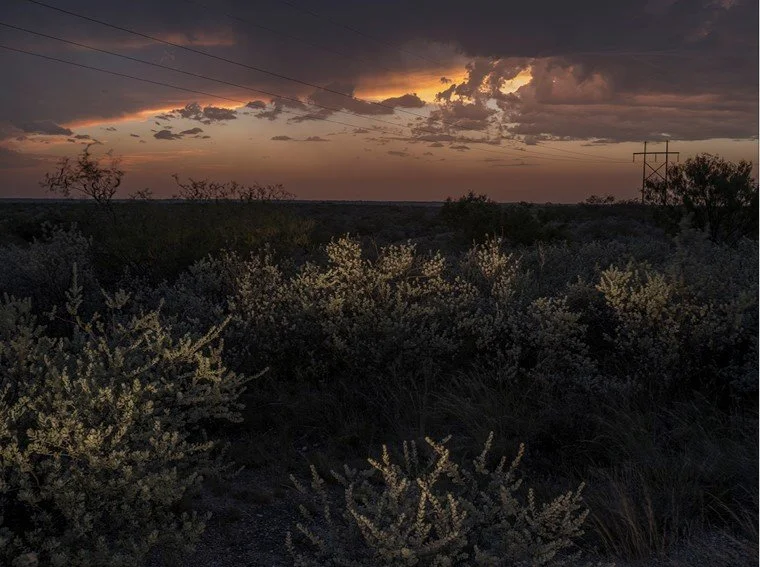
Xavier Tavera’s Borderlands is a photographic exhibition about the U.S.–Mexico border, a landscape where geography, politics, and identity converge in a place that is both contested and shared. Shown together for the first time, this series of landscape and portrait photographs ask viewers to reconsider the border not as a fixed line but as a condition—a place where people live that has been shaped by layered histories and overlapping cultures.
For decades, the U.S.–Mexico border has functioned as both a battleground for policy debates and a mirror for national identity. It is often framed in the news as a threat or a gate to be fortified, obscuring the fact that millions of people live, work, and move across this region every day. Cities like El Paso and Ciudad Juárez, Tijuana and San Diego, are not just international neighbors—they have interconnected economies, families, and languages that complicate the notion of national citizenship. Tavera’s photographs draw attention to these entanglements. The images in Borderlands shift between stark landscapes and intimate portraits, revealing a region shaped not only by policies of exclusion but also by longstanding forms of connection.
Born in Mexico City, and now based in Minneapolis, Tavera has long used photography to center Latino narratives often overlooked in dominant cultural discourse. His previous projects—such as Veteranos/Veteranas and Fictitious—foreground the lives of individuals navigating the complexities of migration and belonging. With Borderlands, Tavera turns his lens toward the physical and symbolic terrain of the border itself. He has traveled from San Diego to the Rio Grande delta, on both sides of the border, to document the landscapes and communities shaped by this complex boundary.
Tavera took his first trip to the border in 2016 when he was completing his MFA at the University of Minnesota. Since then, he has returned many times and taken thousands of photographs capturing the border wall as a “man-made scar.”[i] It’s a structure that creates division yet cannot block the cultural and familial ties of the communities that cross it. Photographed at angles that emphasize the border’s intrusion on the natural landscape, it appears in his photographs less as a boundary and more as a monument to the impossibility of control.
Tavera’s Borderlands photos evoke what Homi K. Bhabha describes as a third space[ii]. This term describes the cultural zone that emerges when different cultures meet. Instead of one culture dominating or mixing with another, something new and unpredictable is created—a hybrid space where identities are reshaped. This third space challenges the idea that culture is fixed. Instead, it highlights creativity, tension, and negotiation. It’s often found in places where people navigate multiple traditions and languages all at once. The third space is where cultural transformation happens. Bhabha believes that cultural exchange always produces something new, not a melting pot where difference is erased.
Along the border, identity is more complex than the citizenship marked in a passport; it is constantly being shaped by history. Tavera, and his camera, travel in this space where lives unfold alongside the rhythms of multiple, overlapping worlds as it is expressed in music, clothing, and language. They show how hybridity itself becomes a way of life. This hybridity can be seen in historical cultural expressions such as Pachuco fashion and the caló dialect, which emerged in the 1930s and 1940s among Mexican American youth in border cities like El Paso and Los Angeles. The Pachuco zoot suit, with its exaggerated silhouette, broad shoulders, and high-waisted trousers, was more than a stylistic choice. At a time when Mexican Americans were being pressured to assimilate, to adopt Anglo norms of behavior and dress, the Pachuco look asserted difference.
Some of Tavera’s photographs are titled with phrases like Near Marfa, TX and Near Douglas, AZ. They are descriptions that suggest proximity rather than location. This imprecision is intentional. He is not photographing borderlands as a fixed place. Instead, his images evoke the experience of searching for the border and never quite finding it—always approaching but never arriving. This echoes cultural theorist Irit Rogoff’s belief that boundaries are not static lines but “zones of […] ambiguity and transformation.” [iii] In Borderlands, the act of almost but not quite locating the border becomes a metaphor for the border’s deeper instability. It is not only a contested geography but a constantly shifting terrain. Tavera photographs were shot in this uncertain space where lives are shaped by a line that is never entirely there.
Tavera’s Borderlands project joins a growing movement of artists reimagining the border through symbolic and participatory acts, such as Ronald Rael and Virginia San Fratello’s Teeter-Totter Wall (2019), in which bright pink seesaws were placed through the slats of the border fence. Children and adults on both sides played together, transforming the wall into a momentary site of connection. Postcommodity’s Repellent Fence (2015) tethered 26 “scare eye” balloons across the border, temporarily marking Indigenous presence across a landscape that has been divided by colonial and national authorities. These projects do not deny the presence of the border. They reinterpret its meaning, turning it from a point of closure into a site of reflection and connection.
The technological dimension of surveillance and control is another critical feature of Borderlands. Multimedia artist Trevor Paglen has documented the often-invisible architecture of America's security apparatus, from spy satellites to remote data centers. His work reveals how power increasingly operates through hidden systems and distant infrastructures. Where Paglen shows the scale and reach of surveillance, Tavera shows its human effects. Together, they reveal a range of border control technologies, from the aerial and institutional to the personal and lived.
In his MFA thesis, Tavera described his photography as “a participatory act,” emphasizing the need for “an ethics of representation that is accountable to the communities being portrayed.” This spirit appears in Borderlands too. His portraits are not taken from a distance; they come from conversations and mutual trust. His subjects do not appear as types or case studies; they are proud individuals, grounded where they are. This is important. Too often, border photography is framed through sensationalism or voyeurism—offering dramatic images of suffering that reinforce distance rather than understanding. Tavera’s work refuses that impulse. His camera listens. He captures gestures of care, moments of humor and pride. His photographs send a clear message: people living in the Borderlands belong there. They are not on the margins or passing through.
Economic displacement and deportation cast a long shadow over the communities in Tavera’s photographs. His work acknowledges the difficulty of living in border areas, while also foregrounding the dignity and resilience of those who endure them. This balance is part of what gives Borderlands its emotional power. Tavera depicts border community members as co-creators of meaning: individuals whose lives resist easy narratives. Whether through a gesture or the details of their personal style, he gives these individuals the opportunity to be seen.
Tavera’s methodology also reflects broader currents in contemporary Latino and borderland art, where themes of hybridity, language, and migration are central. Artists like Delilah Montoya and Tanya Aguiñiga also engage with the aesthetics of the border, crafting works that blur the boundaries between documentary and fiction, testimony and biography. What unites this work is not a shared style, but a refusal to accept the border as a finished fact. To Tavera and these artists, the border is a site of inquiry and invention, shaped not only by policy but by those who live within its shadow.
Many scholars and artists have noted that borders are not only physical barriers but also conceptual constructs. They shape how we think about who belongs, who is visible, who lives here and who lives there. The success of a border, in many ways, lies not just in the construction of a wall, but in how deeply the idea of separation is internalized; how it governs our fears, our assumptions, and our sense of distance from one another. The border is most powerful when it becomes a mental map. And once it’s up, it’s very hard to take down.
Tavera’s photographs challenge this psychological border-making. By documenting those who live with and despite these boundaries, he asks us to see beyond the rhetoric of security and invasion and to notice the quieter, more durable realities of everyday life. His subjects live and work within the spaces that are meant to divide them. These photographs disrupt the idea that borders are inevitable or natural. While borderlands may be surveilled from above and afar, they are lived on the ground.
There are still many questions to be answered: what does it mean to live so close to a boundary that organizes our life? What kinds of relationships persist across the border? What is the future of this area and these people? Borderlands doesn’t answer these questions, but Tavera’s photography does something vital: it shows that even in a long and divided terrain, art travels across borders. Art can break through.
Xavier Tavera: Borderlands is curated by Christopher Atkins, Curator at Sioux City Art Center.
English & Español